Report Published September 12, 2011 · Updated September 12, 2011 · 27 minute read
Incomplete: How Middle Class Schools Aren't Making the Grade
Executive Summary
If you discovered that only one in four graduates from your neighborhood high school would earn a college degree, would you be alarmed?
For decades, there has been a laser-like focus in education reform on the lowest-performing students and schools. This focus continues to be critical for maintaining America’s social fabric and ensuring that all children have an opportunity to succeed, but it is not enough. In this paper, we urge that America must embark upon a second phase of education reform that squarely focuses on dramatically improving achievement in the middle-class schools that the majority of children attend.
Our findings show that middle-class schools seem to be forgotten in the education debate. There is a paucity of academic literature on their performance, expectations, and on ideas for reform. Yet, they produce the students who are the backbone of the U.S. economy. Among parents of school-aged kids in middle-class jurisdictions, there is a strong belief that these schools are educating students at the highest levels. More than seven of ten parents with children in the public schools grade their kids’ schools as either an A or a B,1 and nine of ten parents of school-age children expect their kids to go to college.2 But that is far from the reality. Middle-class schools are falling short on their most basic 21st century mission: to prepare kids to get a college degree.
In order to maintain a prosperous middle class, grow our economy, and foster a public education system that taxpayers deserve, it is necessary to shine a light on the experience of middle-class students. These are students that don’t attend America’s best schools but also don’t attend the worst. They attend the schools that are in every city, town, and suburb. For our nation to succeed, their schools must be college factories—graduating high school students who are prepared to get to and through college.
Yet, this report finds that three out of four middle-class high school graduates today fail to obtain a college degree. In the past, completing high school was sufficient to secure a middle-class life and grow the economy. Today, not completing college warrants an “incomplete.” This stunning statistic must be a national wakeup call to reform and modernize middle-class schools.
Key Findings
In this paper, we focus on middle-class schools and look at their makeup and achievement levels based on the National Assessment of Educational Progress. We separate schools into three categories based on their participation in the National School Lunch Program. Schools with 25% (or less) of students eligible for free or reduced-priced school lunches are considered “wealthy” or upper-income schools. Those with greater than 75% participation are deemed “lower-income” schools. Those with between 26% and 75% eligibility represent our target middle-class schools.
Based on our research using these test scores and funding data from the National Center for Education Statistics of the U.S. Department of Education and the New America Foundation’s Federal Education Budget Project, we show that middle-class schools have a “most, least, and under” problem. They have the most students, the least funding, and are definitively underachieving, specifically in the area of college graduation rate. We offer the following three findings:
1. Most students are taught in middle-class public schools.
- During the 2008-2009 school year, on a per school basis, middle-class schools made up 55% of schools in the U.S.3 and 53% of the public school population.4
- Middle-class schools teach the majority of African-American children (53%), Hispanic children (50%), and white children (56%)5 as well as a plurality of English language learning children (47%)6 when compared to either upper or lower-income schools.
2. Middle-class schools spend the least per pupil, pay teachers the least, and have the highest enrollment to teacher ratios.
- When local, state, and federal monies are combined, middle-class school districts spend the least amount per pupil.7
- Middle-class school districts spent an average of $10,349 per pupil in local, state, and federal funding in 2008.8
- Wealthier school districts spent nearly $11,925 per pupil and the high-poverty school districts spent $11,799 per pupil.9
- Teachers in middle-class schools have more students and are paid the least.
- Middle-class schools have the highest teacher to enrollment ratio: 17.5 as compared to 14.5 (upper-income schools) and 17 (lower-income schools).10
- In middle-class schools, teachers made an average base salary of $48,432 in the 2008-2009 school year.11
- High-income and low-income school teachers made an average of $54,035 and $50,035, respectively.12
3. Middle-class students are underachieving in test scores and college graduation rates.
- Although a majority of middle-class students are achieving the “basic” level score on the national achievement tests, only:
- 30% of 4th graders and 28% of 8th graders at middle-class schools score at the proficiency level on the national reading assessments, and 6% of 4th graders and 2% of 8th graders at those schools score at the advanced level.13
- 36% of 4th graders and 30% of 8th graders at middle-class schools score at the proficiency level on the national math assessments, and 4% of 4th graders and 6% of 8th graders at these schools score at the advanced level.14
- Just 38% of middle-class 12th grade graduates go immediately on to a four- year college.15
- 28% of middle-class high school graduates will earn a four-year college degree by the time they are 26.16
Conclusion
The Economic Imperative
Why is it crucial to improve middle-class schools? Why is it imperative that these schools become college factories? Fifty years ago, good middle-class jobs were bountiful for high school graduates, and individuals could readily prosper without a college degree. Today, the reality is much different. While a college degree is not a guarantee of success, it can and does confer tremendous benefits on the individual who obtains the degree and on a nation that has more college graduates.
Nationally, increasing the number of college graduates from middle-class schools would have a significant economic impact. Over the next decade, nearly two-thirds of job openings will require some post-secondary education, and there will be a shortage of 3 million graduates to fill these jobs.17 In a recent study, researchers found that adding 20 million post-secondary students over the next fifteen years will add $500 billion to the Gross Domestic Product and increase wages for all workers, even those with only a high school diploma.18 Additionally, more college graduates would result in fewer taxpayer dollars going toward social programs such as welfare, housing stipends, food stamps, and unemployment insurance. It is estimated that the taxpayer saves up to $108,000 in government spending for each individual that graduates college versus ending their education with a high school diploma.19
On an individual level, a college degree translates into greater economic security. Annually, college graduates earn $20,000 more in income than high school graduates,20 and over one’s lifetime, the median lifetime earnings for a college graduate is $2.3 million compared to $1.3 million for a high school graduate.21 Even in the tough economic times, college graduates fare better. Only 4.4% of college graduates are currently unemployed while 10% of high school graduates are out of work.22 Also, college graduates are 66% less likely to live in poverty compared to high school graduates23 and are 30% more likely to be covered by an employer-provided retirement plan.24 Improving middle-class schools will have a long-term payoff for the economic growth of the U.S. as well as the individual success of middle-class Americans. The faster we can realize these benefits, the better. A second phase of education reform focused on middle-class schools can’t begin soon enough.
Incomplete: How Middle Class Schools Aren’t Making the Grade
Kristin is in 7th grade at Southern Middle School in Lexington, Kentucky. Her neighbors, like her family, aren’t scraping to get by but aren’t planning lavish vacations. They are comfortable with their jobs and their lives, and they believe their children attend good, middle-class schools. Kristin dreams of becoming a veterinarian or doctor, and, like many of her fellow classmates, expects to graduate from high school and go on to succeed in college. But does this dream come true?
In recent decades, there has been an urgent focus on the lowest-performing schools and students. This focus is necessary and integral to American society in which every child, regardless of circumstance, deserves a real opportunity to succeed. The significant attention paid to the lowest-performing schools has rightfully pointed out that many schools are failing to properly educate their students, and serious, dramatic interventions are needed to turn these schools around.
However, these are not the schools that the majority of Americans send their children to every morning. The majority of Americans generally like their neighborhood schools and think they are doing a good job educating their children. In fact, 77% of American parents give their child’s public school an A or a B grade.25 But the fact is that the majority of these schools are not living up to the expectations that parents, taxpayers, and policymakers have.
The schools that the majority of students attend, middle-class schools, are falling short on their most basic mission—preparing students to graduate from college. 90% of parents think that their child will go onto college,26 but only one in four middle-class high school graduates will obtain a college degree by age 26.27 Even with these shockingly low success rates, there is a deficit of focus, research, or improvement ideas for these schools. There are very few, if any, academic studies focused solely on middle-class schools, and recent academic literature on middle-class schools looks at the academic achievement of lower-income students when they attend traditionally middle-class schools rather than the needs and challenges of the middle-class schools.28 There was no mention of middle-class schools in the Obama Administration’s Blueprint for reauthorization of the Elementary and Secondary Education Act (ESEA).29 Even though the recent initiative, Race to the Top, encompassed all schools and focused on pursuing excellence for all students, this $4 billion fund is only a drop in the bucket of total yearly education spending.30
Only one in four middle-class high school graduates will obtain a college degree
As a result, middle-class students are at risk of being forgotten. Their schools are not crumbling, gang-ridden, or dropout factories inhabited by kids in the throes of desperation. They are not “waiting for Superman.” But they are not pillars of learning and achievement. For middle-class students, obtaining a college degree is an exception, not a rule. And in today’s economy, a college degree is a necessity—not a luxury. Middle-class schools must produce students ready to be the backbone of the U.S. economy to ensure that America can compete in a changing, globalizing economy. But as it stands now, they are an afterthought—the middle child—neither living up to these lofty expectations nor getting the attention and support that they need to do better.
In order to maintain a prosperous middle class, grow our economy, and foster a public education system that taxpayers deserve, it is necessary to shine a light on the experience of middle-class students. These are students that don’t attend America’s best schools but also don’t attend the worst. They attend the schools that are in every city, town, and suburb. In this paper, we call for a second phase of education reform—one that includes a focus on middle-class schools—so that the U.S. has the education system that parents, taxpayers, and policymakers expect for their communities.
With this report, we take the first step in establishing this second phase. We look at middle-class schools to determine who they are, whom they serve, and how they perform. We argue that the nation needs a conscious and urgent focus on middle-class schools because they have challenges and needs that are not being addressed by the current education reform debate. In order to spur economic growth in the 21st century, we have to recognize where middle-class schools are today and where they need to be in the future.
Finding #1
Most students are taught in middle class schools.
In order to isolate middle-class schools, we group public schools into three categories: upper-income, middle-income, and lower-income schools based on the percentage of students in the school (and school districts when individual school data was unavailable) eligible for the National School Lunch Program (NSLP). Upper-income schools are defined as those with 25% or less of the student body eligible for the NSLP, and lower-income schools are those in which more than 75% of the student body is eligible for the NSLP. This parallels the U.S. Department of Education’s definition of lower-poverty and higher-poverty schools and school districts.31 Middle-class schools are those with 26% to 75% of the student body eligible for the NSLP. In the 2011-2012 school year, the income eligibility for a family of four is $29,055 for free lunch and $41,348 for reduced lunch.32 For more information about how and why we divided up the nation’s public schools, please see the Appendix.
The majority of students and schools are middle class.
As the table below shows, middle-class schools make up the majority of schools in the U.S. The majority of students attend these schools, and the majority of teachers teach at these schools.
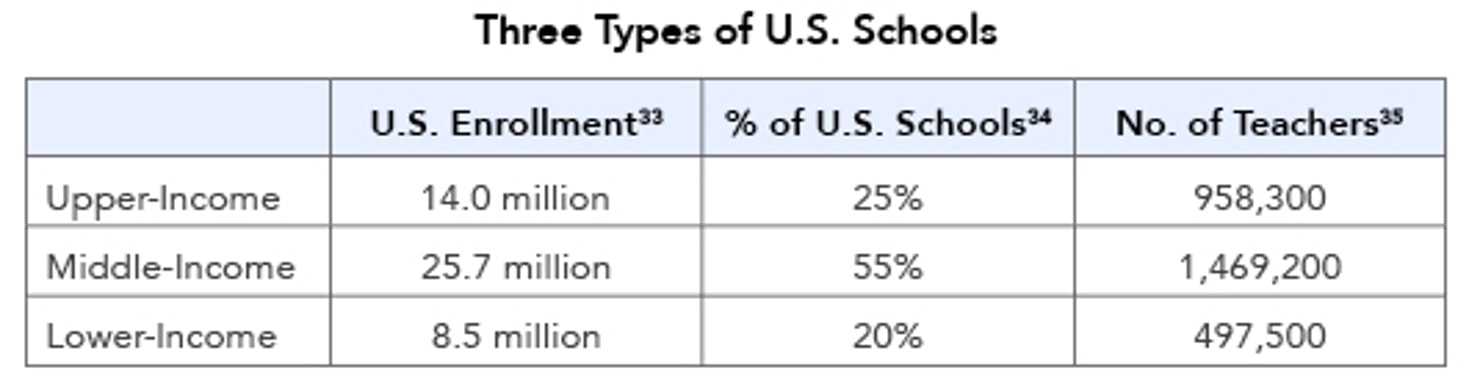
Chart endnote: 33 34 35
Additionally, middle-class schools serve the majority of white, black, Hispanic, and American Indian students as well as a plurality of Asian students. A lack of focus on middle-class schools in education reform means that policymakers do not impact the majority of students from all races and ethnicities.
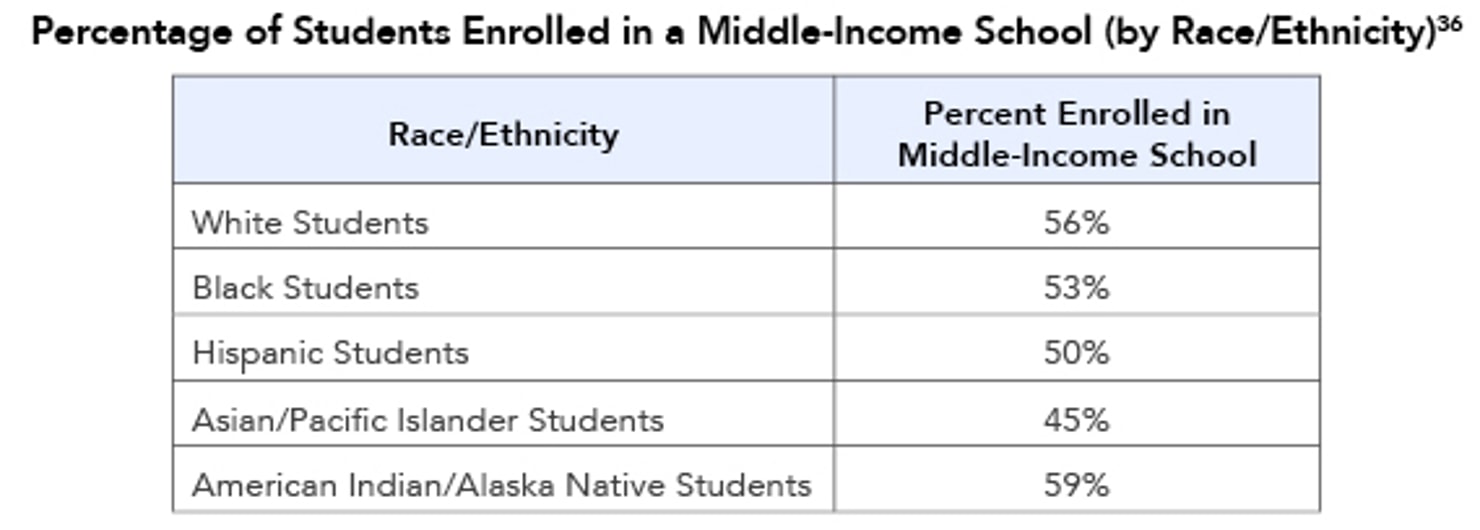
Chart endnote: 36
Middle-class schools are located across the country.
Middle-class schools are located in every neighborhood and in every state. Even in urban locations, the current focal point of education reform, half of the high schools and four-in-ten elementary schools fall into the middle-class category.
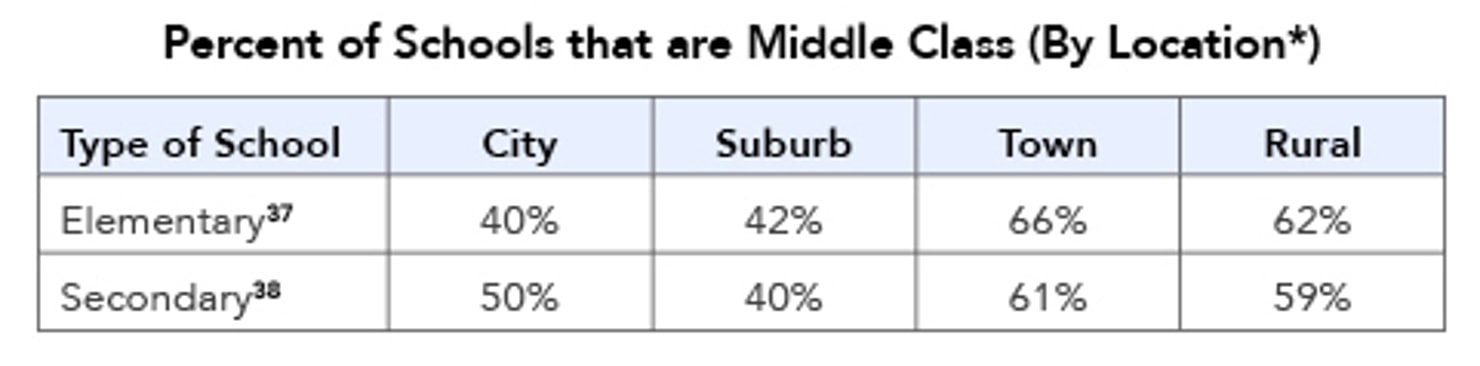
Chart endnote: 37 38
The Common Core Data uses the following definitions for a city, suburb, town, and rural area. City: an urbanized area with an area with a population greater than 100,000; Suburb: a territory outside an urbanized area with a population less than 250,000; Town: a territory more than 10 miles from an urbanized center; and Rural area: a census-defined rural territory 5 or more miles from an urbanized center. For more information about the definition of locales, please visit: http://nces.ed.gov/ccd/rural_locales.asp.
The communities surrounding middle-class schools are solidly middle income, with aspirations to do better for their children. According to the U.S. Census Bureau, the national median household income in 2009 was $49,777.39 As seen in the table below, the median income for middle-class school districts is $51,739, in 2009 dollars, just slightly above the national median household income. It is important to note that the median household income figure includes households led by 18 year olds as well as 89 year olds, both groups with less-than-steady annual incomes. Therefore, the actual median income for households with school age children is probably significantly higher for middle-income school districts.
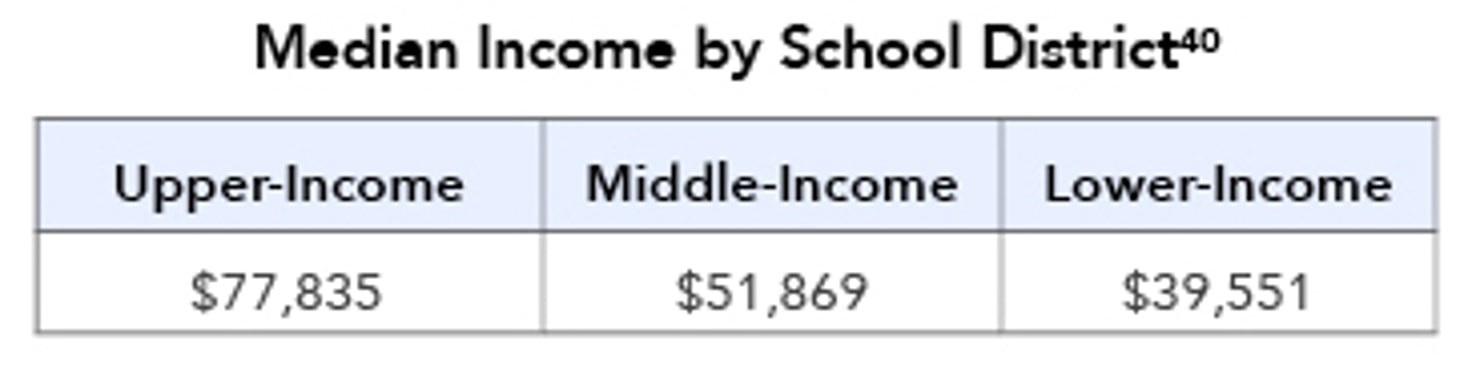
Chart endnote: 40
Middle-class schools represent the majority of Americans. They educate the majority of students, employ the majority of teachers, and are in every city and suburb. But they are being left out of the education reform debate to the detriment of millions of students, parents, and teachers.
Finding #2
Middle-class students get less.
Middle-class schools, on the whole, receive less than upper-income and lower-income schools. As we explore in the following section, middle-class students spend less per student, middle-class teachers are paid the least, and middle-class schools have the highest teacher-student enrollment ratios. With these schools producing the engine of the U.S. economy, America’s middle class, they may not be receiving what they need to sufficiently educate students to be ready to compete in the 21st century economy.
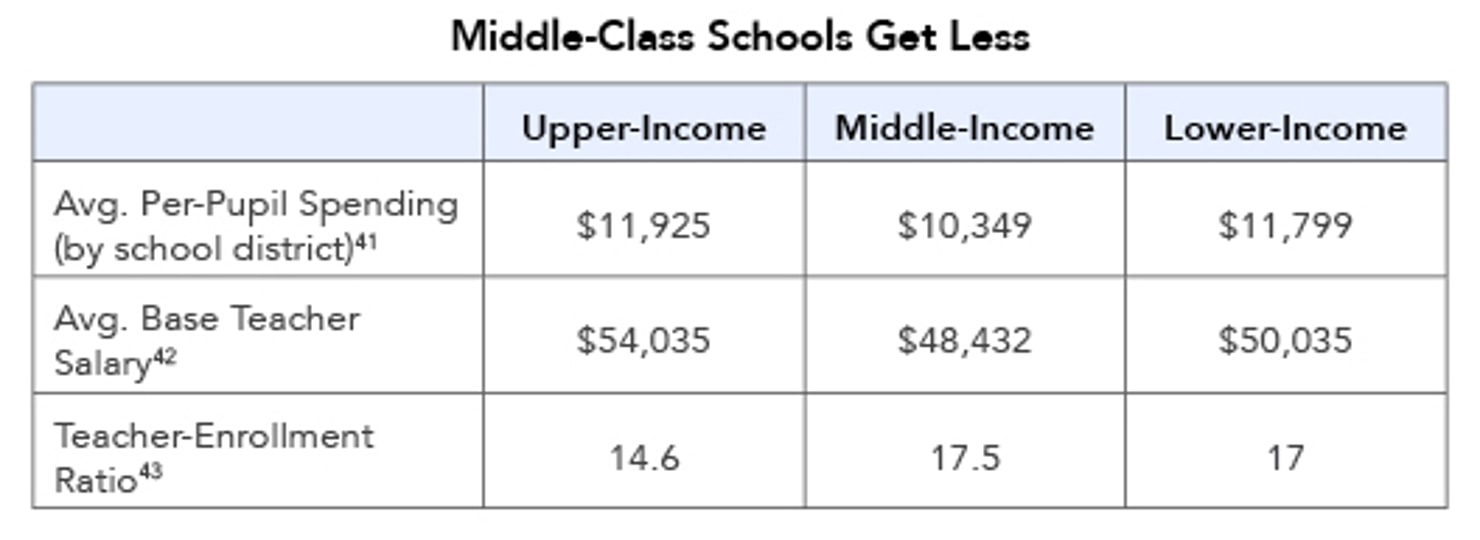
Chart endnotes: 41 42 43
Per-pupil spending at middle-class schools is at the bottom of the barrel.
Middle-class schools, while educating the most students, spend the least amount of funding per pupil. On average, middle-class school districts spend $1,500 less per pupil than their counterparts, which magnified over an entire school, results in $1 million less in spending for the schools.44 This is money that could go toward hiring extra teachers to reduce class sizes, creating innovative programming for students and teachers, paying top-notch teachers better wages, and providing additional support staff to help with students needing extra tutoring.
Middle-class schools also spent less federal funding than lower-income schools. The Elementary and Secondary Education Act (ESEA) was designed to be the federal government’s intervention to ensure that disadvantaged and minority students receive a quality education. Therefore, lower-income schools receive significantly more Title I money,45 the largest part of ESEA, as well as more federal funding overall.
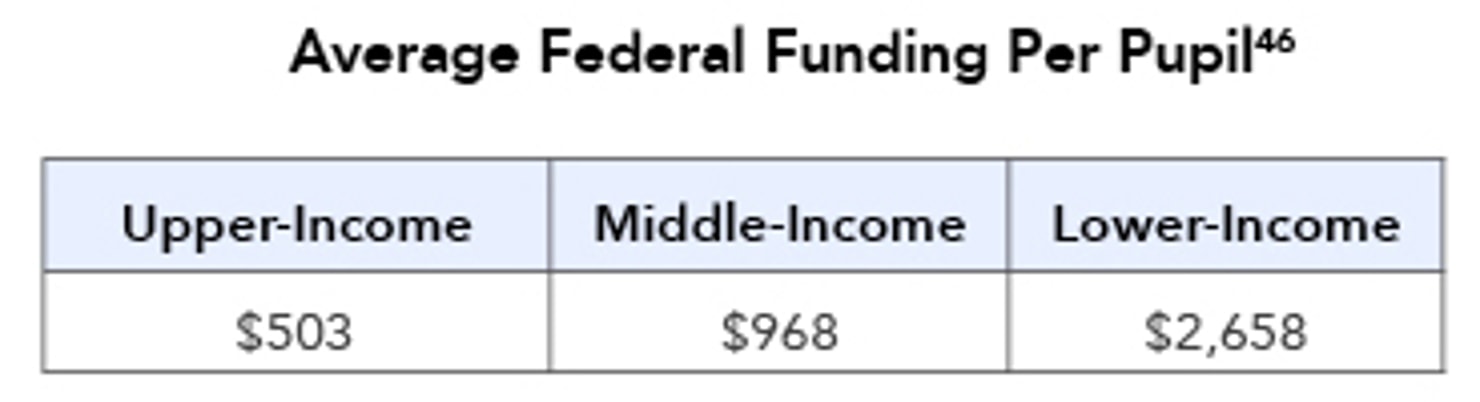
Chart endnote: 46
Teachers in middle-class schools are paid the least.
When we look at teachers at the three types of schools, we see a dip in the incomes for the average teacher at a middle-class school. These teachers make thousands of dollars less than their counterparts at upper and lower-income schools.
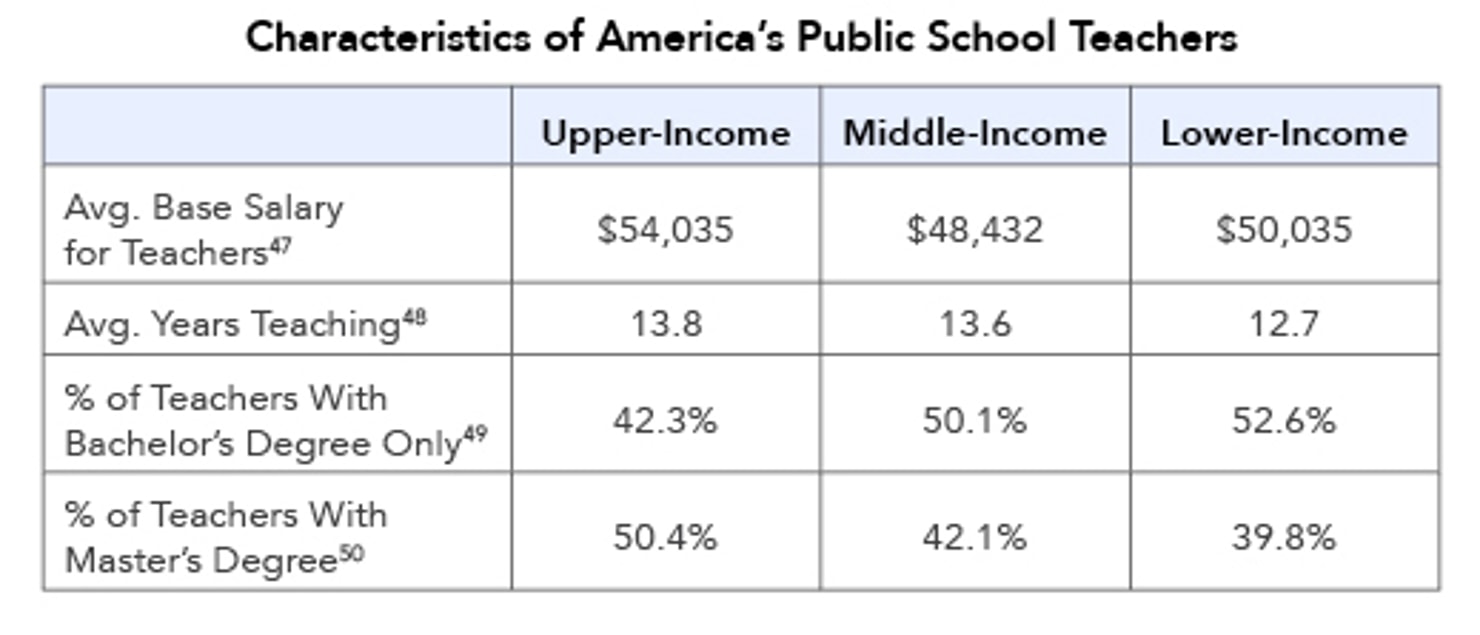
Chart endnote: 47 48 49 50
Interestingly, teachers at middle-class schools and lower-income schools have similar credentials, and middle-class teachers and upper-income teachers have similar years of experience. Yet, teachers at middle-class schools are, on average, paid thousands of dollars less than their counterparts at both ends of the spectrum.
Middle-class schools are getting left behind. In per-pupil spending, in teacher salaries, and in enrollment ratios, middle-class schools are not keeping up with their competition. And yet, students in these schools are being left out of the discussions about how to improve America’s schools. The reality is that the students at middle-class schools are struggling to meet the achievement standards necessary for the U.S. to lead in the expanding global economy.
Finding #3
Middle-class students are underachieving.
Students in middle-class schools are performing at underwhelming levels. They aren’t failing or falling hopelessly behind, but they aren’t leading the pack either. 77% of parents of public school students give their child’s school an A or a B grade,51 but 47% of Americans think that students today are not as prepared for work or college as they were when they were in school.52 In this section, we take a look at how students at middle-class schools are performing to give an accurate assessment of where we are today and where we need to improve in order to grow our economy over the next century.
National Achievement—Underwhelming at Best
Middle-class students aren’t struggling to learn the basic skills, but they aren’t receiving gold medals in achievement either. Even though the vast majority of parents have a positive view of their children’s schools and 58% rate their local elementary school as good or excellent,53 the achievement scores do not match up with these beliefs and expectations. There is significant room to improve the students at middle-class schools from “C” students to “A” and “B” students.
Annually, a representative sample of students nationwide takes the National Assessment of Educational Progress (NAEP), also known as the Nation’s Report Card. Students are tested in a variety of different subject areas and grade levels, and they are scored as either achieving advanced, proficiency, basic, or below basic in a specific subject. The Commissioner of Education Statistics, under the U.S. Department of Education, is responsible for overseeing the NAEP. The National Assessment Governing Board, an independent, bipartisan board appointed by the Secretary of Education, is responsible for determining the framework and the assessments given. The Board also defines basic, proficient, and advanced levels for each grade and subject assessed.54
Achieving 100% proficiency on NAEP exams is a goal that all schools should be striving for. Yet, as seen in the student achievement data below, middle-class students’ results are underwhelming. Middle-class schools see a majority of their students meet the basic level but struggle to see the majority of their students achieve “proficiency”.
Basic: “This level denotes partial mastery of prerequisite knowledge and skills that are fundamental for proficient work at each grade.”55
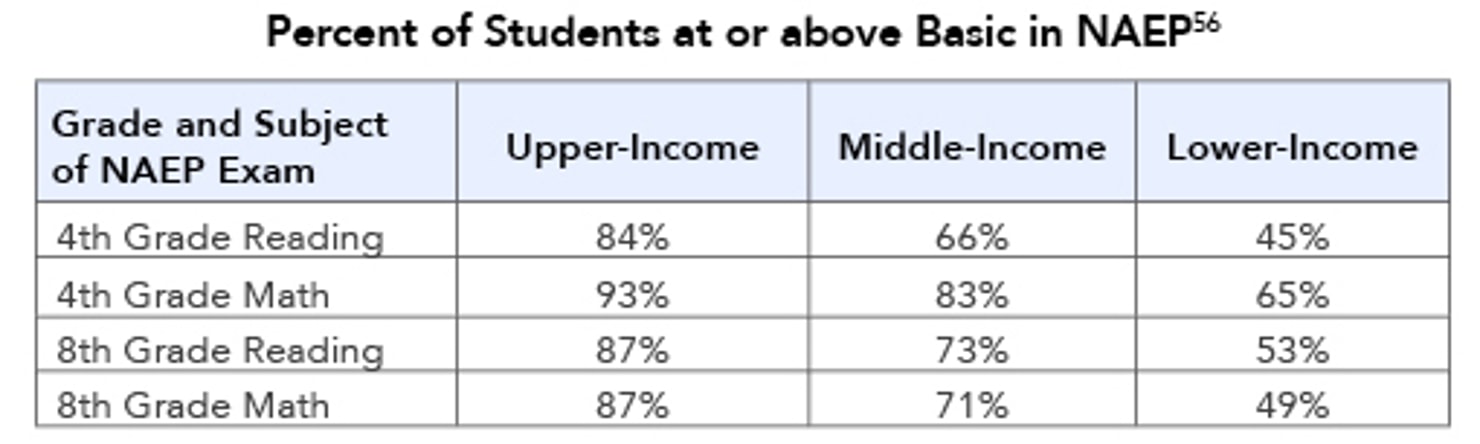
Chart endnote: 56
Proficient: “This level represents solid academic performance for each grade assessed. Students reaching this level have demonstrated competency over challenging subject matter, including subject-matter knowledge, application of such knowledge to real world situations, and analytical skills appropriate to the subject matter.”57
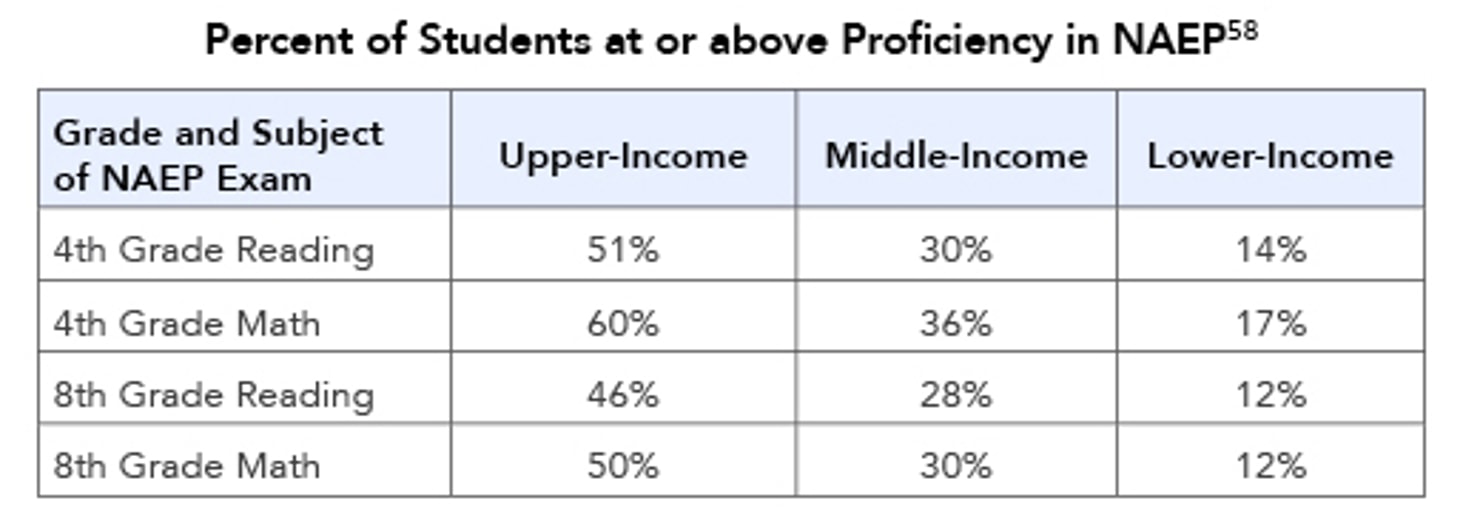
Chart endnote: 58
Advanced: “This level signifies superior performance.”59
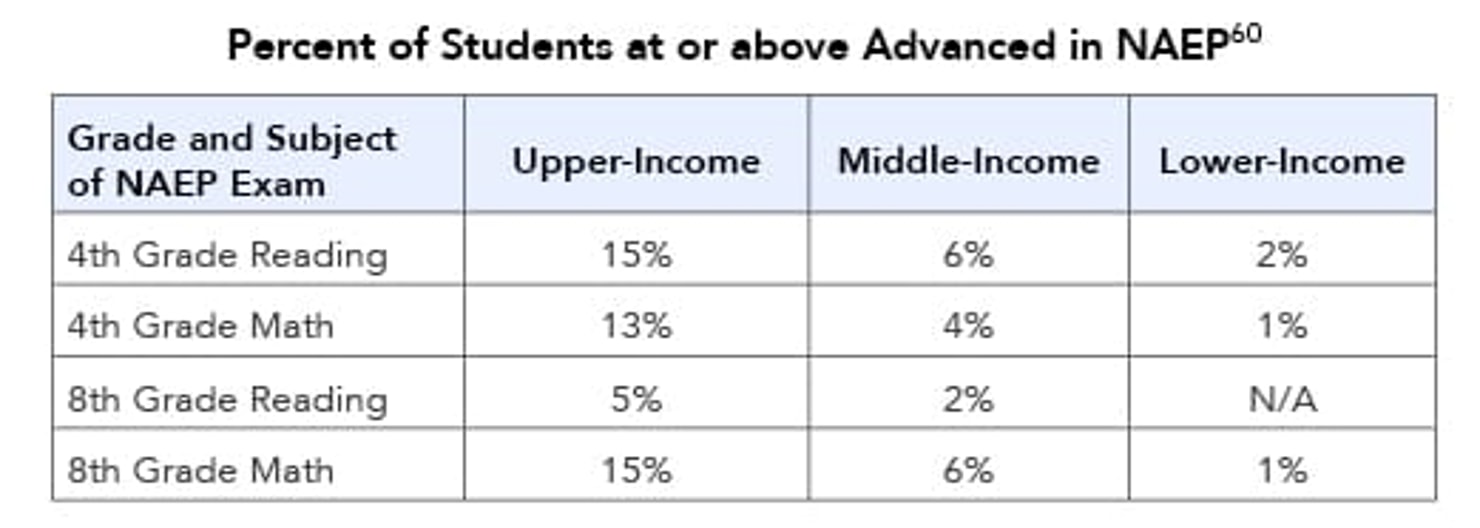
Chart endnote: 60
Middle-class students and parents need to confront the gap between where their level of achievement is and where it needs to be in order ensure economic success for themselves and the country. The middle class is the backbone of a robust economy, but middle-class schools aren’t producing enough students that achieve at the highest levels. That has to change.
The College Reality—A Degree is a Rarity, not a Given
Americans put a high value on a college education. 75% think that a college degree is very important in today’s economy, compared to only 36% in 1978.61 And 92% of parents think that their child will go to college.62 Nationally, however, the college graduation rate leaves much to be desired. A college freshman has barely more than a 50-50 chance (57%) of graduating with a bachelor’s degree in six years.63 When we break down educational outcomes by school type, we see middle-class schools are not living up to their parents’ expectations.
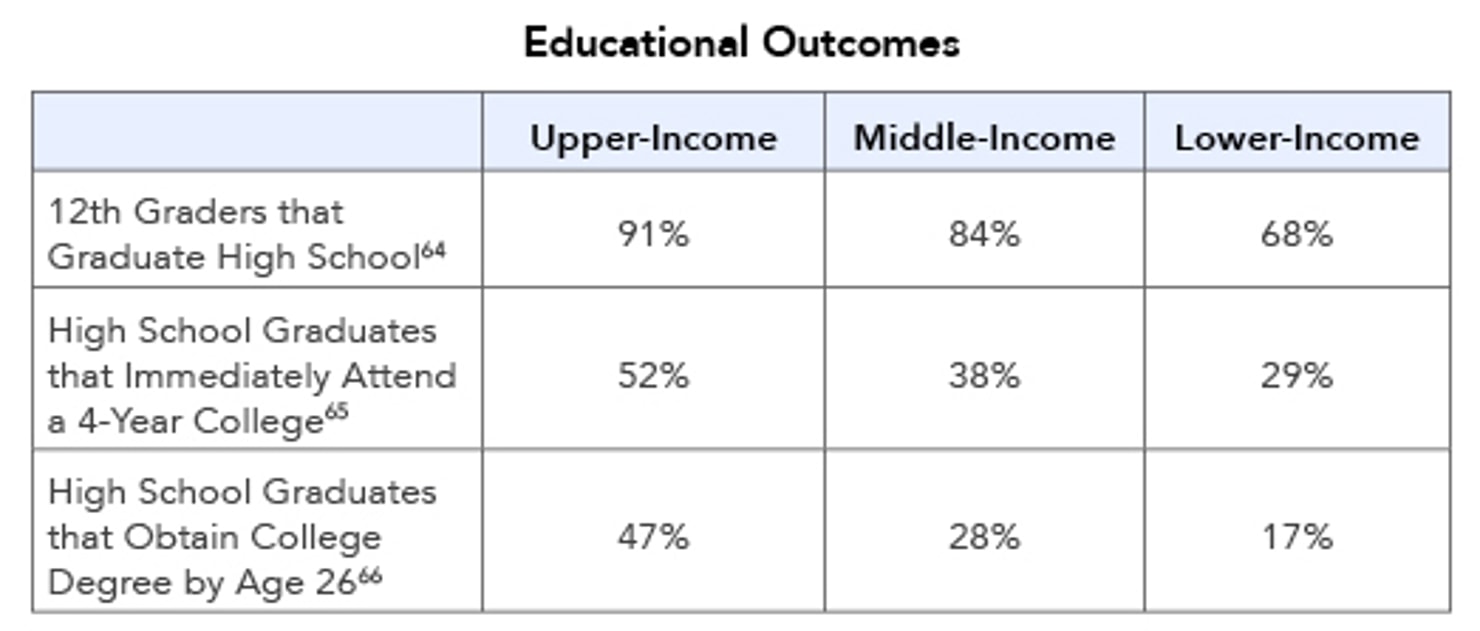
Chart endnotes: 64 65 66
Middle-class schools have not reached the benchmark of sending even half of their students to college within their first year out of high school, making them more similar to lower-income schools than to their wealthier counterparts. There is no doubt that some of the 62% of students that do not enroll in a four-year college immediately after graduation will still be successful. 28% of middle-class high school completers go directly onto a two-year college,67 and 28% (or one out of thirteen middle-class high school graduates) will complete a two-year degree.68 Additionally, research shows that 9.7% of high school graduates going onto a two-year college following high school will transfer to a four-year school and complete their bachelor’s degree.69 Some middle-class high school graduates will join the military, and 9.0% of college freshman wait a year to enter college.70 However, based on our estimates, only one out of four middle-class high school graduates will obtain a college diploma by the time they are 26.71
A significant number of middle-class students—the backbone of the U.S. economy and leader of economic growth—will likely only take a few college courses and leave without ever obtaining a degree. With a college degree becoming increasingly important to attaining not only economic stability, but to simply achieving gainful employment, middle-class students find themselves in danger of being left behind in the global economy.
The Economic Imperative
The Impact of Middle-Class Schools Making the Grade
Fifty years ago, it was not an economic necessity to graduate from college in order to live a prosperous life, and there was not a great economic need for more college graduates. Good middle-class jobs were bountiful for high school graduates, and individuals could readily prosper without a college degree. However, today the reality is much different. In many fields, having a college degree is a necessity rather than something that is just nice to have, and thousands of jobs in the near future need to be filled by workers with a bachelor’s degree. If middle-class schools become college factories in which they graduate students that are prepared to get to and through college, there will be positive economic impact for both the individual who obtains the degree and the nation that has more college graduates.
The National Economic Impact
Consistently, when policymakers talk about the economic potential of improving public schools, they focus on improvements to the achievement of the lowest-performing students. Many studies over the years have looked at the economic impact of raising student achievement at the lowest-performing schools. In an April 2009 report by McKinsey & Company, researchers found that if the U.S. had improved the overall student achievement levels to those of Finland and Korea, the Gross Domestic Product of the U.S. would have been 9% to 16% higher in 2008 than it was.72 If lower-income students made similar educational gains, the GDP in 2008 would have been 3% to 5% higher than it was.73 But what is the economic impact of helping our “C” students at middle-class schools become “A’s” or “B’s”?
Over the next decade, nearly two-thirds of job openings will require some post-secondary education, and currently, there will be a shortage of 3 million graduates to fill these jobs.74 In a recent study, economists Anthony Carnevale and Stephen Rose of Georgetown University point out that the U.S. has been under-producing workers with a college degree for the past several decades. If the U.S. adds 20 million post-secondary educated students (including students that obtain an associate’s degree and those that have some college but no degree), the U.S. GDP would not only increase by $500 billion,75 but it would also raise incomes for all workers, not just those that obtain a degree.76 For example, workers with only a high school diploma would see their incomes rise by 24%.77
Additionally, more college graduates would result in less taxpayer dollars going toward social programs such as welfare, housing stipends, food stamps, and unemployment insurance. It is estimated that the taxpayer saves up to $108,000 in government spending for each individual that graduates college versus ending their education with a high school diploma.78
The Individual Economic Impact
On an individual level, a college degree translates into greater economic security. Annually, college graduates earn $20,000 more in income than high school graduates, $46,931 versus $27,381, respectively,79 and over one’s lifetime, the median lifetime earnings for a college graduate is $2.3 million compared to $1.3 million for a high school graduate.80 Even in tough economic times, college graduates fare better. Only 4.4% of college graduates are currently unemployed while 10% of high school graduates are out of work.81 Also, college graduates are 66% less likely to live in poverty compared to high school graduates82 and are 30% more likely to be covered by an employer-provided retirement plan.83 A college degree leads to more economic security and fulfilled aspirations such as saving for a comfortable retirement, being able to send their own kids to college, and starting a small business. But with only one in four middle-class high school graduates obtaining a college degree, the economic ripple effect of improving middle-class educational outcomes is still waiting in the wings. Improving middle-class schools will have a long-term payoff in the economic growth of the U.S. as well as the individual success of middle-class Americans.
Conclusion
A Middle-Class Education Agenda
Through our analysis of schools, communities, students, and teachers, it is evident that middle-class schools and middle-class students are not performing at the levels that parents, taxpayers, and policymakers think they are. Middle-class schools are underachieving. They struggle to have a majority of students reach proficiency on the national achievement tests or to send a majority of students to college. They spend the least amount per pupil and have the highest teacher-enrollment ratios even though they serve the majority of students.
But the problem with middle-class schools is more than just a national economic problem. It affects every single child that attends a middle-class school with mediocre performance. Will Kristin from Lexington be the one in four of her middle-class friends that graduates with a college degree? Will she be part of the 60% of middle-class students that achieve “proficiency” on NAEP exams? Or will she continue down the current middle-class education path towards mediocrity? In order to guarantee that students like Kristin are able to achieve at a higher level, middle-class schools need the time, energy, and attention of policymakers in order to improve their standing from “okay” to leaders of the global economy.
With this report, we hope to ignite the conversation about middle-class schools. These schools are important to the fabric of American society and the strength of the U.S. economy. But they also need the attention and focus that they are not currently receiving. A move into a second phase of education reform—a focus on middle-class schools—would ensure that these schools receive the attention they deserve and ensure that students like Kristin are prepared with the skills necessary to succeed. In future papers, we will explore policy solutions that will directly benefit middle-class schools. These policy solutions, no doubt, could also help upper and lower-income schools, but it’s important to recognize that education reforms directed toward improving middle-class schools are needed. We, as Americans, cannot continue to ignore the status of middle-class schools, and it is prudent for economic, social, and good-government reasons to bring middle-class schools into the fold of education reform.
Appendix I
How We Define Middle-Class Schools
For the purposes of investigating the different types of schools and school districts, we used the eligibility for the National School Lunch Program,84 also known as free or reduced lunch, as a surrogate for poverty and low income. In order to be eligible for the Free Lunch program, a family’s income must be equal to or less than 130% of the Federal poverty guideline, and a family’s income must be between 130% and 185% of the Federal poverty guidelines to be eligible for the Reduced Lunch program. In the 2011-2012 school year, the income eligibility for a family of four is $29,055 for free lunch and $41,348 for reduced lunch.85 We divided the schools (and school districts when individual school data was not available) by the percentage of students eligible for the National School Lunch Program (NSLP), and we came up with three types of schools: upper-income, middle-income, and lower-income.
We define schools and school districts with 25% or less of their students eligible for the NSLP as upper-income schools. For lower-income, high-poverty schools, we parallel the U.S. Department of Education’s definition of high-poverty and define them as schools and school districts with more than 75% of students qualifying for NSLP.86 The schools and school districts with 26% to 75% of their student population eligible for NSLP we define as middle-income, middle-class schools. There are some characteristics in which the schools with 51-75% of their student population eligible for the NSLP look more like lower-income schools than middle-class schools. However, for our purposes, we think that defining middle-class schools as those with 26% to 75% NSLP eligibility is the most accurate description of schools in the middle. The following chart provides the core characteristics of schools by all four quartiles of NSLP eligibility.
A lot of the government data on schools by eligibility for the NSLP is broken down into quartiles (0-25%, 26-50%, 51-75%, and 76-100%). For many of the calculations, we had to weight the data for the two middle quartiles in order to determine the percentage of a characteristic affecting middle-class schools. All data sources and steps we took to get to each finding are in the following endnotes.
Appendix II
The Big Picture
The charts below compare core characteristics and the academic achievement of America’s public schools, broken down by the population in a school’s student body that is eligible for the National School Lunch Program (NSLP). The middle-class schools—highlighted in yellow—do not perform at the levels that parents and taxpayers think they do, but there has been little time, energy, or focus paid on improving the achievement of these schools.
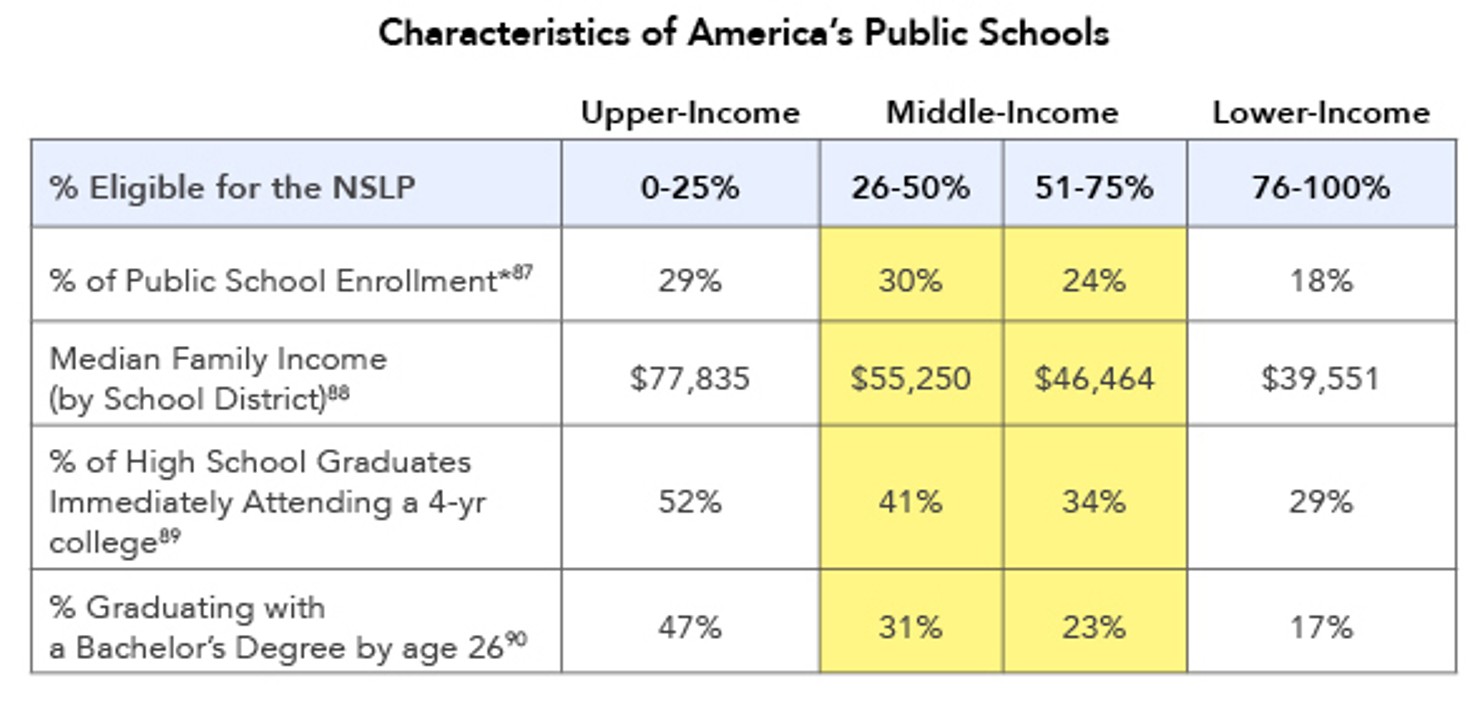
Chart endnotes: 87 88 89 90
Total enrollment does not add up to 100% due to rounding.
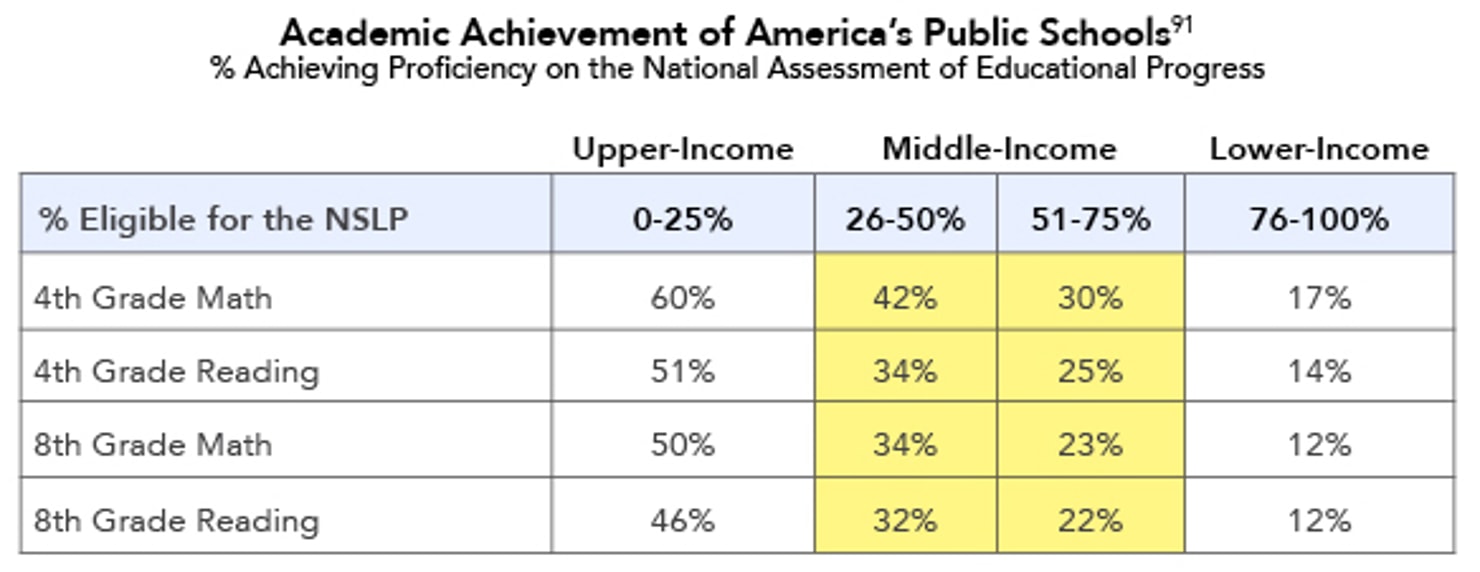
Chart endnote: 91
Appendix III
International Achievement of Middle-Class Schools
Recently, much attention has been directed towards the achievement of U.S. students in comparison to the perennial achievement powerhouses like Singapore, Finland, and South Korea.92 Overall, the U.S. has ranked 23rd in science, 17th in reading, and 30th in math internationally,93 but looking at these rankings on face value doesn’t give an accurate portrait of U.S. achievement. There is no doubt that the U.S. is losing to its competitors, but when we isolate the achievement of middle-class students on the Trends in International Mathematics and Science Study, which tests international achievement in math and science for 4th graders and 8th graders, we find that the U.S. ranking jumps.
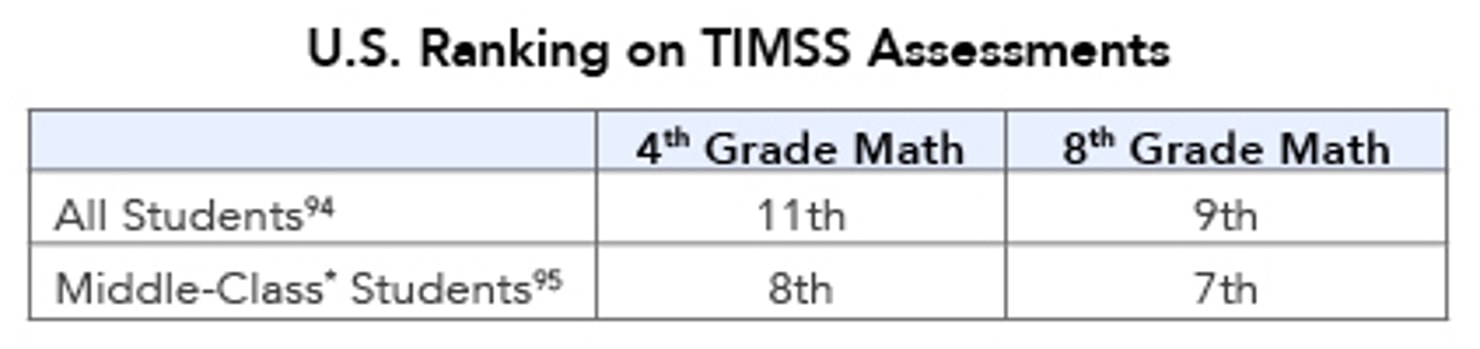
Chart endnotes: 94 95
Based on percentage of students reported to be from “economically disadvantaged” backgrounds by school administrators. For this calculation, we defined lower-income schools as over 50% of the population at the school is from an economically disadvantaged background and upper-income schools with between 0-25% of student population from a disadvantaged background. Middle-class schools were defined as 26-50% because the breakdown of schools from 51-75% was not available.
